
Nitinol: Medtech’s Biggest Innovation... And Biggest Roadblock

Nitinol is becoming a critical material for next-generation medical devices because its shape-memory and superelastic behavior enable stents, orthopedic fixation devices, guidewires, and neurovascular tools to flex, compress, deploy, and recover shape inside the body. But those same properties make nitinol difficult to machine, creating demand for non-contact, non-thermal processes like PECM that reduce burrs, recast, tool pressure, and surface-integrity risks.
The shape-memory alloy Nitinol has arguably become the most important material in medical device manufacturing. It has enabled incredible new medical devices with increased flexibility, compressibility, deployability, and fatigue strength: all while being able to move through constrained areas before returning to a controlled shape.
The FDA has helped integrate the gradual transition of medical devices towards nitinol in the past decades, describing nitinol’s extensive use in cardiovascular devices such as stents, heart valves, guidewires, and vena cava filters, with growing use in new areas, especially in minimally invasive procedures (U.S. Food and Drug Administration).
Nitinol’s increased usage and applicability has been well-received by patients, medical practitioners and design engineers alike— but many manufacturers have not shared that positive sentiment. Nitinol certainly helps unlock better device functionality, but it also introduces considerable machining and finishing challenges that conventional methods sometimes struggle to work around. As nitinol medical devices become smaller, more intricate, and more performance-sensitive, the manufacturing method becomes part of the device-design strategy. In this article, we’ll explain the cause of nitinol’s rise across medtech, why conventional methods are struggling to keep up, and how Voxel’s PECM methodology offers a new solution at scale.
Nitinol is also a good example of why PECM fit should be evaluated at the application level. The material may be conductive and burr-sensitive, but the practical manufacturing path still depends on feature geometry, edge requirements, electrolyte access, tolerance targets, inspection strategy, and annual volume.
Key Takeaways
Nitinol is increasingly important in medtech because it supports shape recovery, superelasticity, kink resistance, and fatigue-loaded device designs.
Its strongest use cases include stents, heart-valve frames, guidewires, orthopedic fixation devices, and newer neurovascular tools.
Nitinol is difficult to machine because it is tough, elastic, strain-hardening, heat-sensitive, and highly dependent on finished surface condition.
Conventional machining, laser cutting, EDM, and downstream finishing each have useful roles, but each also introduces tradeoffs.
PECM may offer a non-contact electrochemical route for selected conductive nitinol features where burrs, thermal damage, recast, tool pressure, edge consistency, or repeatability create production risk.
Why nitinol keeps showing up in next-generation devices

Nitinol is an extremely unique material: it is a nickel-titanium alloy that is almost entirely “equiatomic”, meaning it has nearly equal amounts of nickel and titanium. While the presence of those materials do not make Nitinol inherently special, two key material behaviours of nitinol do set it apart:
Shape memory allows a nitinol component to recover a pre-determined geometry under the right thermal conditions. In other words, manufacturers could shape nitinol wire into a complex geometry, heat treat it while in that shape, and the component will “remember” that geometry even if it is bent into another geometry by simply heating it at a certain temperature.
Superelasticity allows substantial deformation of a nitinol component, and it will still be capable of returning to its “pre-programmed” geometry.
Working on a conductive nitinol feature that looks promising for PECM, or one that seems borderline but keeps creating burr, thermal, recast, post-processing, inspection, or repeatability problems? Send Voxel the material, geometry, tolerance target, current process, and expected volume for a fit review.
Consider how in medical environments, these devices undergo geometric transformations for a wide number of reasons: it may need to be constrained during delivery and then expand/flex/grip/support, or perhaps return to its “pre-programmed” shape after delivery. Unlike other materials that may be chosen due to their strength or corrosion resistance, Nitinol completely transforms how a component can be shaped and delivered into the patient.
Interested in learning another way? Check out this AI-enabled podcast summary of this article.
Let’s review a few examples of Nitinol in action:
Stents are an excellent example. A vascular stent must perform three core functions perfectly, in order:
Collapse into a small delivery-friendly geometry
Be inserted and travel safely through the patient vasculature and then, most importantly,
Expand with a controlled radial force into their “pre-programmed” geometry

Illustration of stent device within a vascular system. Credit: Wikimedia Commons
Another key area Nitinol is utilized is in the orthopedic world. Many orthopedic devices use nitinol’s shape-memory and superelastic behavior to create active compression across bone. Staples, plates, clips, and fixation devices can be designed so the implant applies a sustained compressive force after placement: extremely in procedures where bone segments need to be held together during healing, including osteotomies, arthrodesis, and fracture fixation. Nitinol’s elasticity is especially useful in anatomical areas that undergo constant movement such as in the feet (as opposed to a tibia bone, for instance).
Consider how different this acts from a titanium or stainless fixation device that holds geometry because it is mechanically rigid. A nitinol implant can be designed to recover toward a programmed shape, helping maintain compression even as bone surfaces settle, small gaps close, or local loading changes.
Nitinol's presence in stents and orthopedic fixture devices is fairly well-known, but it is also moving into smaller, more specialized device categories:
Guidewires and delivery systems: Nitinol’s flexibility and kink resistance help devices navigate challenging anatomy while maintaining what is called “pushability” and shape recovery
Neurovascular devices: Stent retrievers and clot-retrieval tools also rely on fine nitinol structures that can collapse for delivery through extremely small vessels, then expand to engage thrombus in the brain’s vasculature. Literature on neurovascular stent retrievers describes these devices as “nitinol structures designed to remove clots from blood vessels in the brain, with microfabricated surface features being explored to improve thrombectomy performance”. (NCBI)
Dental and orthodontic devices: Orthodontic archwires are a key nitinol application as they can apply relatively consistent corrective force over a useful range of deflection (setting teeth into certain shapes over prolonged periods).
Application Area | Why Nitinol Matters | Manufacturing Pressure |
Cardiovascular stents | Self-expansion, radial force, fatigue resistance | Thin struts, clean edges, consistent geometry |
Heart-valve frames | Collapsible delivery and shape recovery | Complex frames, fatigue-loaded features |
Orthopedic fixation | Shape recovery and sustained compression | Controlled edges, repeatable implant geometry |
Guidewires and delivery systems | Flexibility, kink resistance, pushability | Long, slender, small-diameter features |
Neurovascular devices | Delivery through tortuous anatomy and expansion at target site | Microfeatures, thin structures, high surface sensitivity |
Dental and orthodontic devices | Consistent corrective force over a useful deflection range | Fine wire geometry, predictable spring behaviour |
This increased range of nitinol usage across medical devices is, however, creating new challenges for manufacturers. But why is nitinol challenging to machine?
Why nitinol is difficult to machine
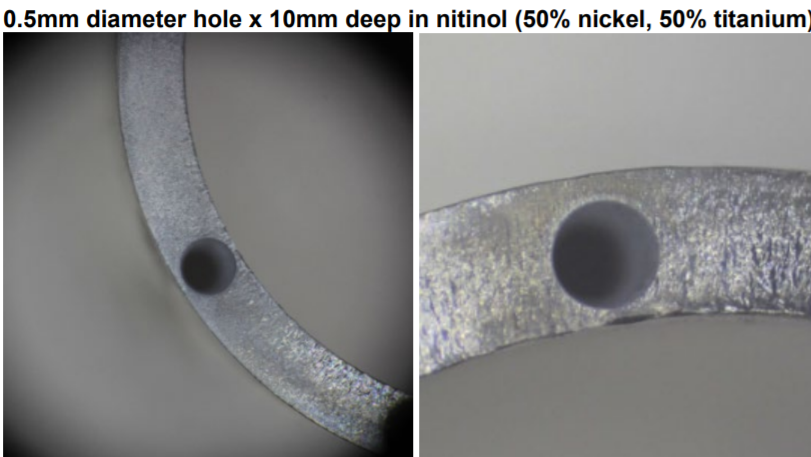
The “double-edged sword” allegory we utilize often—of extremely corrosion and heat-resistant materials like inconel being the precise reasons it is hard to machine—also applies to Nitinol, but for different reasons. Nitinol’s unique properties (being elastic, tough, heat-sensitive, and prone to strain-hardening) makes it fundamentally different on the workbench than other medical metals like stainless steel, Ti64, or cobalt-chrome.
Research on electrochemical microslot machining states it is difficult to machine conventionally because of high strength, toughness, strain hardening, and heat generation. (MDPI) Those machining difficulties show up in several ways:
First, consider mechanical cutting methods such as milling, drilling, and grinding. These methods are accustomed to applying force into a material that does not elastically recover. With Nitinol’s superelasticity, that creates unique problems with dimensional control, burr formation, surface roughness, and tool stability. For instance, nitinol resists predictable chip formation during machining. Instead of shearing cleanly, nitinol can deflect, recover, smear, or work-harden near the cutting zone, making it harder to maintain a stable tool-workpiece interaction-- notably on small features, thin sections, or flexible geometries. The result? Inconsistent surface roughness, faster degradation of cutting performance, and a higher risk that the machining process itself introduces the surface defects the device designer is trying to avoid are but a few consequences.
A common mistake is treating nitinol like a harder version of stainless steel or titanium. Its value comes from recoverable deformation and programmed shape behavior, so machining defects can matter differently than they would on a conventional rigid component. The process question is usually tied to whether the finished feature still supports deployment, fatigue performance, edge condition, and inspection requirements.
Thermal processes like laser or EDM have their own tradeoffs. Laser cutting is widely used for the smaller nitinol devices including stent-like structures. In fact, a recent review of laser cutting of NiTi shape-memory alloys describes laser cutting as the most widespread cutting technology micro-nitinol devices (ScienceDirect). Laser cutting, EDM, and wire EDM avoid the cutting-force challenges of mechanical machining, but they remove material through highly localized heat. Nitinol’s very performance depends on maintaining uniform microstructure, transformation capabilities, and surface quality. Yet, surface irregularities commonly introduced from thermal machining (HAZ, recast, microcracks) can alter fatigue behaviour, or interfere with downstream finishing. For a material whose value comes from predictable recovery and repeated deformation, thermal damage near the finished edge can become a functional manufacturing concern.
A feature that looks like a strong PECM candidate still needs review. Conductive material, thermal sensitivity, and fine geometry are useful signals, yet they do not confirm process fit by themselves. Cathode approach, electrolyte flow, masking or isolation needs, tolerance stack, and expected production volume can change the answer.
Finishing and postprocessing methods, while able to fix many of the aforementioned problems, come with their own challenges. Whether it's electropolishing, chemical finishing, blasting, tumbling, or abrasive methods, postprocessing may improve burrs or surface roughness but may also change critical dimensions, round edges, alter small features, or introduce variation across complex geometry. On a large part with a simple geometry, that might be manageable—but on a thin nitinol device like a mesh or a neurovascular device in the brain, the finishing process is absolutely essential. On thin nitinol devices such as mesh structures or neurovascular components, finishing decisions can directly affect edge condition, surface quality, dimensional control, and inspection burden.
Why PECM fits the nitinol manufacturing problem
Capability Area | PECM Relevance for Nitinol |
Material fit | Electrically conductive nitinol and other advanced medical alloys require application-specific evaluation. |
Best-fit geometries | Slots, grooves, mesh-like openings, thin-wall features, microfeatures, and difficult-access edges. |
Process mechanism | Non-contact electrochemical material removal. |
Thermal impact | No EDM-style recast layer from the PECM step. |
Edge condition | Strong fit where burr reduction and edge consistency are central requirements. |
Tooling behaviour | Cathode tooling with minimal tool wear compared with conventional cutting tools. |
Scale-up relevance | Parallel feature processing for repeated patterns, arrays, and fine openings. |
Production model | Process development, tooling, machine logic, and manufacturing pathway developed together. |
Medical-device relevance | Useful where the finished feature affects deployment, fatigue performance, cleaning, or inspection strategy. |
This is where Voxel’s vertically integrated model matters. PECM is not only a material-removal method; it requires cathode/tooling strategy, electrolyte methodology, machine behavior, fixturing, inspection planning, and production assumptions to work together.
PECM, or pulsed electrochemical machining, approaches the problem differently. Instead of cutting nitinol with a mechanical edge or melting it with a thermal process, PECM removes conductive material through a controlled electrochemical reaction.
That distinction may seem superfluous but genuinely matters: Nitinol machining problems often center on force, heat, burrs, tool pressure, recast, and surface integrity, but PECM reduces many of those mechanisms at the source, as the process does not rely on physical cutting contact between a tool edge and the workpiece.

For conductive nitinol components, PECM is especially relevant when the geometry includes small slots, grooves, mesh-like openings, thin-wall features, internal features, or edges that cannot tolerate uncontrolled burrs. PECM also fits applications where laser or EDM processes create too much downstream burden because the customer must remove recast, manage thermal effects, or protect fine geometry during post-processing.
As nitinol use expands across medtech, the manufacturing challenge is not limited to making one difficult feature once; OEMs increasingly need a credible path from prototype geometry to repeatable production. PECM is well suited to that scale-up problem because the process can machine multiple features in parallel rather than treating every slot, groove, or microfeature as a separate toolpath event. It also uses cathode tooling with minimal tool wear, supporting more stable feature replication across production runs than many conventional cutting processes. For selected nitinol components with repeated patterns, fine openings, or arrays of small features, that combination can make PECM worth evaluating as a production strategy rather than only a specialty development method.
The manufacturing takeaway
Early review matters...early PECM review can help engineering teams identify which nitinol features create the most manufacturing risk: edge condition, heat exposure, post-processing burden, tolerance control, inspection access, or repeatability. In some cases, PECM may support a cleaner route to production. In others, review may clarify that laser cutting, EDM, electropolishing, or a hybrid route remains the better path.
Nitinol is gaining ground because medtech devices increasingly need to flex, recover, collapse, expand, and survive repeated loading. That is true in established categories such as cardiovascular stents and heart-valve frames. It is also true in newer or smaller applications such as neurovascular devices, steerable systems, microfeatured delivery tools, and advanced orthopedic fixation.
But nitinol’s value depends on preserving the material behaviour that makes it useful. A poorly controlled manufacturing process can create burrs, recast, heat-affected surfaces, dimensional drift, or surface integrity problems that undermine the design intent.
That is why nitinol should not be treated as just another difficult alloy. It is a functional material, and functional materials need manufacturing methods that protect function.
For the right conductive nitinol application, PECM gives engineers another route: a non-contact, electrochemical process for producing difficult features without the same cutting-force and thermal-damage mechanisms found in many conventional workflows. As nitinol devices become smaller and more complex, that difference becomes more than a process detail. It becomes a design-enabling manufacturing strategy.
Working on a conductive nitinol feature that looks promising for PECM, or one that seems borderline but keeps creating burr, thermal, recast, post-processing, inspection, or repeatability problems? Send Voxel the material, geometry, tolerance target, current process, and expected volume for a fit review.

Comments