
PECM & Aesthetic Microneedle and Cannula Devices

Updated: Aug 14

Both needles and cannula (the latter being a more blunt-tipped injection device) are the simplest-looking component in aesthetic or cosmetic surgical procedures, but are arguably the most important. The manufacturing challenges behind these ultra-thin metal cylinders are fundamentally based in scale: whether every needle in a set, or every cannula off a production run, behaves like the one next to it. Two very different devices (hollow cannulas used for dermal filler and fat grafting, and solid microneedle arrays used for collagen-induction skin treatments) both depend equally on the scalability and repeatability of the manufacturing processes used to make them. Sources will be hyperlinked at bottom of article.
Key Takeaways
• Hollow cannulas and solid microneedle arrays look like different products, but both depend on feature-to-feature consistency rather than the quality of any single needle.
• Cannula performance is, at its core, a fluid-dynamics problem as opposed to a sharpness problem
• Microneedling, a procedure, and its clinical effect depends on a documented wound-healing methodology (TGF and PDGF release), and that only acts predictably if every needle in the array reaches a consistent depth.
• PECM's own corner-rounding physics can, under some circumstances, be beneficial for producing these components at-scale
• These are high-volume, cost-sensitive disposable components, a different profile than the implants and surgical tools covered elsewhere in medtech, and still warrant a per-device review before assuming fit
A quick primer: the devices we'll discuss in this article are used in some of the most common procedures in aesthetic medicine: hyaluronic acid filler injections for lip augmentation and wrinkle treatment, fat grafting for facial or body contouring, and microneedling for skin texture, fine lines, and scarring. The American Society of Plastic Surgeons reported 28.2 million minimally invasive cosmetic procedures performed in 2024 (with HA filler injections alone accounting for roughly 7 million of them) and minimally invasive procedures as a category grew 7% in 2023, outpacing surgical procedure growth.
Two Categories, One Shared Problem
First- what is the difference between a needle (array) and cannula when it comes to cosmetic/aesthetic procedures? The mechanical difference comes down to how each device interacts with tissue.

A cannula is blunt-tipped and typically has one or two entry points, and material moves through a single internal lumen (hollow interior channel) as the cannula is advanced and withdrawn beneath the skin, often with one or more side ports along the shaft rather than an opening at the tip. It is better at moving through tissue without cutting.
A microneedling array works the opposite way: dozens to hundreds of solid, sharp points make simultaneous, independent punctures across a grid, and no fluid travels through any of them in a purely mechanical device.
"Consistency" means something different for each device. For a cannula, it's the bore diameter and the port (opening for fluids to exit/enter) geometry holding steady along the shaft. For a microneedle array, it's depth and sharpness holding steady across every point in the grid, since a single shallow or dull needle in a 24-needle cartridge affects that portion of the treatment area on its own.
Hollow cannulas and solid microneedle arrays fail in different ways, but the root cause is usually the same: inconsistency across features rather than a defect in any one feature. A dermal filler or fat-grafting cannula is a hollow tube with a blunt or rounded tip and, often, one or more side ports; its job is to move material through a lumen without damaging tissue on the way in. A microneedling cartridge, however, is a dense array of solid, sharp points whose job is the opposite: controlled and purposeful tissue penetration.
What Matters for Cannula: Lumen Consistency and Burr-Free Bores
Think of the fundamental challenge of a cannula injecting hyaluronic acid into a patient's lip as a fluid-dynamics problem before it is a sharpness problem. Peer-reviewed work on fat-grafting cannulas, for instance, has shown that internal diameter (predictably) governs the particle size of injected fat, with "...14-gauge or larger cannulas producing deposits large enough to risk central necrosis when injecting a full cc per pass, while smaller-bore cannulas produce more uniform, better-surviving graft particles..." (PubMed, Architecture of Fat Grafting II). So manufacturers prioritize small, consistent, high-Ra internal bores.

A 2025 electron-microscopy study of dermal filler and biostimulator cannulas went a step further, examining lumen geometry directly. Suspension-based fillers (which basically suspend solid microparticles in a carrier fluid rather than forming a single smooth gel), turned out to be particularly sensitive to bore consistency and obstruction-free lumens, which makes sense.
A gel-only filler can tolerate minor bore imperfections fairly well it moves through a cannula predictably as it is a fairly physically consistent substance; a suspension, however, does not. The particles inside a suspension fluid can catch or clump at a burr or an inconsistent diameter in a way a smooth gel never would. Hence, the study ties flow resistance and clogging risk directly back to how cleanly the internal bore was manufactured (Journal of Cosmetic Dermatology, 2025).
So...why aren't gels always used for these procedures?
Gels simply add volume to a specific area, which the body can naturally break down over months or years. Suspension fluids with specific substances like calcium hydroxylapatite or poly-L-lactic acid particles actually stimulate the body's own collagen production around those particles.
Fundamentally, surface inconsistencies, such as burrs, inside a small-bore lumen is challenging because it isn't inspectable by eye. Teams asking about burr free cannulated screw cross hole manufacturing are usually working through the same core problem in a different device category, a hollow feature where the internal condition matters as much as the external one, and where a visual pass/fail check on the outside tells you nothing about what's happening inside the bore. Side ports on a cannula raise a related but distinct question: how to deburr cross drilled holes without changing diameter, since a deburring step that rounds or enlarges the port even slightly changes flow rate through that specific opening, which is exactly the kind of dimensional drift a bore-sensitive application can't absorb.
If lumen consistency, cross-port deburring, or tip sharpness is part of what's driving a spec on a filler cannula, fat-grafting device, or microneedling array, send Mike or Kirk the material, feature geometry, and tolerance target. A short technical discussion is usually enough to know whether the hollow-lumen side of the device, the solid-tip side, or both are a fit for PECM. Contact us at info@voxelinnovations.com.
So what happens when a burr forms in a cannula's lumen? A few issues.
Uneven flow through an obstructed lumen means the clinician can't dose smoothly or predictably, often needing more pressure and more passes to deliver the same volume, which increases tissue trauma and bruising.
For fat grafting specifically, particles forced past a burr can shear or fragment, and fragmented fat grafts survive at lower rates than intact ones.
For suspension fillers, product can clump or deposit unevenly at the point of obstruction, raising the risk of visible lumps or an inconsistent result under the skin rather than the smooth correction the product is designed for.
Solid Arrays: Why Depth and Sharpness Consistency Drives the Biological Response
As we discuss the concept of needles, it's important to briefly clarify we are not discussing injectable needles used in conventional procedures, but an array of small, short needles used solely for cosmetic/aesthetic procedures called microneedling.

Microneedling's use depends on a specific, documented wound-healing "cascade" that provides cosmetic and aesthetic benefits. Controlled micro-injuries trigger specific chemical releases from surrounding platelets and neutrophils, which ultimately release new collagen, elastin, and glycosaminoglycan production (PMC, Physiological Mechanisms and Therapeutic Applications of Microneedling). Studies have reported dermal collagen density increases of up to 400% over a six-month treatment series (PMC, comprehensive review of microneedling applications and outcomes).
But microneedling must be extremely precise: that cascade only fires predictably if every needle in the array reaches a consistent depth and penetrates with consistent force. An uneven array delivers an inconsistent treatment across the treated area since the wound-healing response in the under-treated zones simply won't match the response where depth and sharpness were on target; it defeats the entire purpose of cosmetic surgery.
Radio-frequency-assisted arrays add a second consistency requirement on top of depth, being energy delivery per needle, which is a separate engineering problem from the mechanical geometry question this article focuses on, but still worth mentioning.
So what happens when an array of microneedles is uneven, from a depth, pitch, or surface quality standpoint?
If it's needle depth, the "intentional injury" of the bad needle can affect the collagen-induction response in that area, making uneven recovery
If it's bad needle pitch (area between each needle), micro-injuries can be concentrated in some areas but leaves gaps in others
Importantly, if it's uneven surface roughness, a rough needle can increase the drag on the insertion or withdrawal mechanics, tearing tissue at the entry point rather than creating the clean puncture the treatment depends on, shedding more debris into the tissue with each pass-- both a medical and aesthetic problem.
How These Parts are Typically Made at Scale
Most solid microneedles and hollow cannulas are produced using methods that were built for speed, not for holding tight, part-to-part tolerance across a full production run.
Solid needle arrays are commonly stamped or ground from sheet or wire stock, a process that is fast and inexpensive per unit. However, during these processes, tool wear over a run can gradually shift needle height, sharpness, and pitch as more units come off the same tooling.
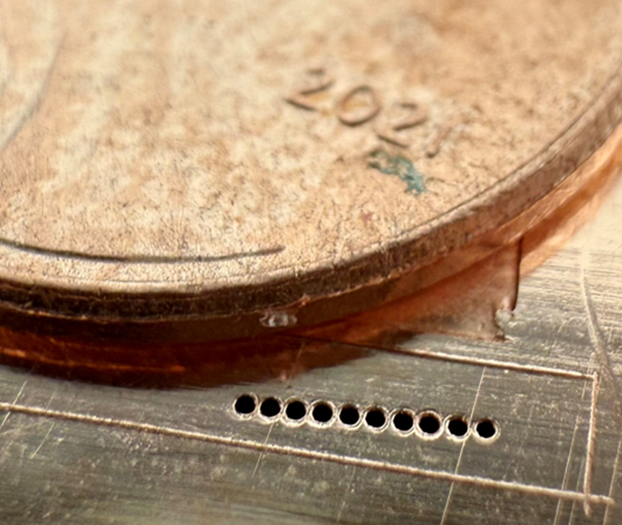
Hollow cannulas typically start as drawn or swaged metal tubing, which is then cut, ground to a bevel or tip geometry, and in many designs has a side port machined or laser-cut into the shaft.
Fundamentally, each of those secondary steps (cutting, grinding, laser drilling) is its own opportunity to introduce a burr or an inconsistency at the exact feature, the tip or the port, where consistency matters most clinically.
This is where the repeatability problem compounds rather than averages out. A stamping die or grinding wheel produces minimal tool wear part-to-part in the short run, but that wear is cumulative, so unit 50 off a production run is not identical to unit 5,000, even though both technically meet the drawing.
Laser-cut ports can leave a thin recast layer or heat-affected zone at the port edge that a purely visual inspection will not catch. None of this means these methods are the wrong choice for high-volume disposable devices; cost and throughput matter enormously at this volume. It does mean that the process controls and inspection plan around these methods need to be built for drift across a lot, not just conformance at the start of one.
Electropolishing is often proposed as a finishing step for either device family, but it carries its own risk. Electropolishing titanium medical device dimensional change is a documented concern, since the process removes material somewhat unevenly across a part's geometry, which can be tolerable on a simple external surface but problematic on a small-bore lumen or a fine tip where a few microns of uneven removal changes performance. Unlike electropolishing, PECM does not rely on a broad chemical etch across the whole part, it removes material through a shaped tool and controlled current, which is part of why it holds tighter dimensional control on small, geometrically sensitive features.
Material and Edge Condition: PECM's Limits & Capabilities
PECM's applicability for these components is mixed. A sharp penetrating point is a case where PECM's own physics can work against the part. Our earlier piece on sharp and rounded edges covered why current density concentrates at convex corners in PECM, rounding them over rather than holding them crisp, useful for a controlled edge break, a real limitation for a feature that needs to stay needle-sharp. A hollow cannula tip often needs a controlled bevel or rounded edge, which plays to PECM's strengths, while a solid microneedle's penetrating point needs to stay sharp, which generally favors grinding or another mechanical sharpening step instead...yet their usage in dense arrays can signficantly benefit from PECM's repeatability.

These are high-volume, disposable, cost-sensitive components, a different manufacturing profile than the implants and surgical tools covered elsewhere in medtech. A filler cannula or a microneedling cartridge is typically single-use and produced at volumes far beyond, say, a bone plate or a stapler anvil, which changes the economics of where a burr-free, tool-wear-free process like PECM earns its cost relative to CNC or grinding. None of this settles the question for a specific device. Whether a given cannula or array is a strong PECM candidate still depends on lumen size, port geometry, needle material, and array density, a per-device determination rather than a category-wide answer.
Here are PECM's broad benefits:
Internal surface quality: PECM produces a smooth, burr-free internal bore without a mechanical tool contacting the surface, which is exactly the lumen consistency problem the earlier sections describe.
Small, high-aspect-ratio features: Side ports, narrow lumens, and other small internal geometries that are difficult to reach with a grinding wheel or a mechanical tool are well suited to PECM's non-contact material removal.
High repeatability across dense arrays: PECM has demonstrated strong part-to-part consistency in other high-density array applications, such as semiconductor microhole arrays, which is directly relevant to holding depth and pitch consistent across a full microneedle array rather than letting it drift over a production run.
A per-device review typically comes down to a short list: lumen or bore size and tolerance, port or side-aperture geometry if present, needle or cannula material, array density for microneedle products, and expected production volume. None of these variables can be assessed from a generic product description, which is why this stays an engineering conversation rather than a specification a vendor can quote sight-unseen.
Device Feature | Consistency Variable | Best-Suited Process |
Hollow cannula lumen (filler, fat grafting) | Internal bore diameter, burr-free bore | PECM |
Cross-port / side aperture on a cannula | Aperture size without altering bore diameter | PECM (non-contact deburr) |
Solid microneedle penetrating tip | Sharpness, consistent depth across array | Grinding or mechanical sharpening |
Needle/cannula shaft finish | Surface roughness, dimensional stability | PECM (avoids electropolish dimensional drift) |
If lumen consistency, cross-port deburring, or tip sharpness is part of what's driving a spec on a filler cannula, fat-grafting device, or microneedling array, send Mike or Kirk the material, feature geometry, and tolerance target. A short technical discussion is usually enough to know whether the hollow-lumen side of the device, the solid-tip side, or both are a fit for PECM. Contact us at info@voxelinnovations.com.


Comments