
A Deep-Dive on Inconel (And Why PECM Thrives on It)

Nickel superalloys are engineered to survive some of the most extreme environments and resist heat deformation, corrosion, and fatigue. Predictably, those same traits make them some of the hardest metals to machine conventionally.
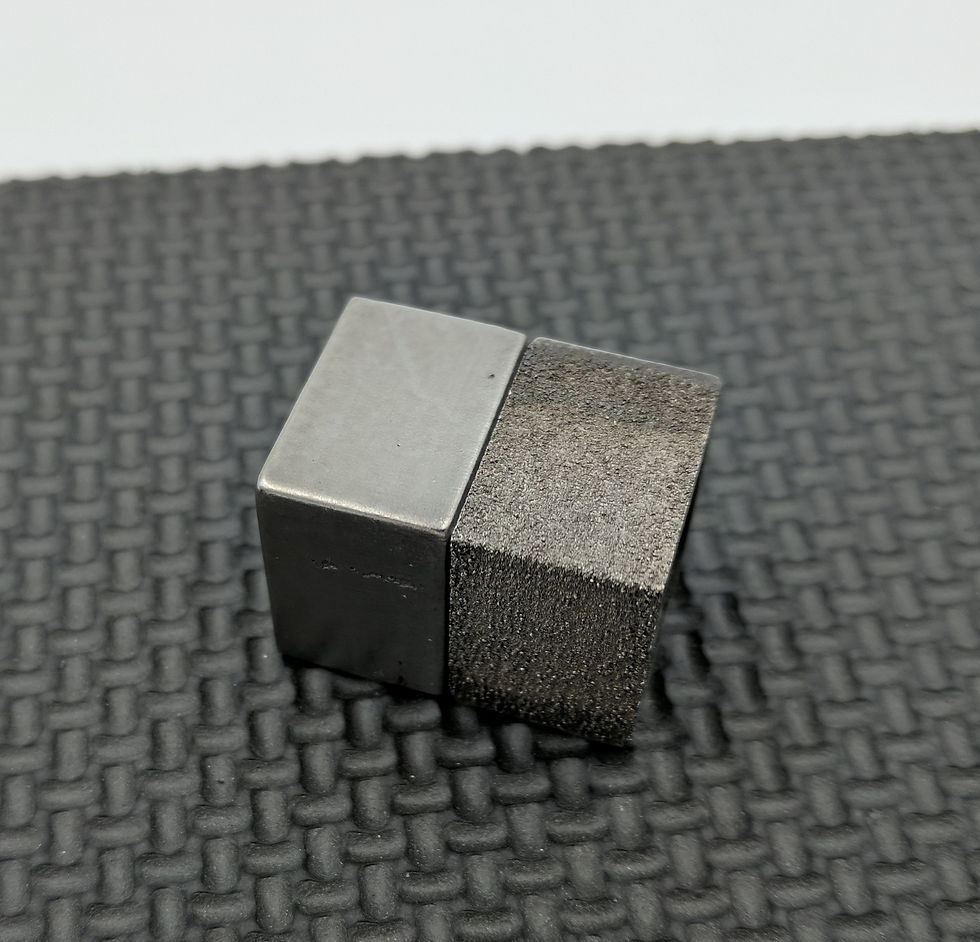
Inconel is a family of incredibly strong nickel-chromium superalloys, with the ability to sustain itself in extreme environments: from cryogenic temperatures in space up to roughly 700 °C in aircraft engines. Turbine/rocket engines, oil and gas infrastructure, and nuclear hardware are but a few critical applications that depend on Inconel to survive. Yet, Inconel can be a nightmare for machine shops: the strength and work-hardening effects that make Inconel valuable wear through cutting tools and slow every operation, as we'll explain.
Pulsed electrochemical machining (PECM) removes metal by controlled dissolution instead of cutting, so Inconel's hardness has little-to-no effect on how PECM removes material.
And for more on superalloys: our 2021 superalloys overview introduced the broader superalloy family. This article, however, goes deeper on Inconel itself: its chemistry, its grades, why it's increasingly 3D printed, and why it's one of the materials PECM handles best.
Key Takeaways
• Inconel grades are nickel-chromium alloys strengthened either by dissolved elements (625) or by heat-treated precipitates (718).
• Inconel's work-hardening and strength at temperature make CNC slow and tool-hungry, while EDM and laser drilling leave recast layers and heat-affected zones.
• Additive manufacturing unlocks internal cooling channels and consolidated parts in Inconel, and moves the finishing problem inside the part.
• PECM removes Inconel without heat, contact or mechanical stress, which makes it one of our strongest materials for microholes, slots, arrays and AM post-processing.
So, What Makes Inconel, Inconel?
Inconel variants are all structured around a nickel-chromium base, with each addition fine-tuning its strength/corrosion/weldability, etc. Specifically, Nickel provides a stable face-centered cubic matrix that holds its strength at temperature, and chromium forms a protective oxide that resists corrosion and oxidation. The other materials (such as the refractories molybdenum and niobium) are added in different proportions depending on the grade.
Inconel 718 is a fan-favorite. Its composition is:
50–55 % nickel (plus cobalt),
17–21 % chromium,
4,75–5,5 % niobium (plus tantalum),
2,8–3,3 % molybdenum,
0,65–1,15 % titanium, and
0,2–0,8 % aluminum... with iron making up the balance.

While each material plays a critical role, the titanium, aluminum and niobium are especially important for 718. When 718 is aged (roughly 600–815 °C) they precipitate as nanoscale gamma-prime (γ′) and gamma-double-prime (γ″) particles that block dislocations from moving through the matrix. Grades like 625, on the other hand, skip the precipitate step and get their strength from molybdenum and niobium dissolved directly in the nickel matrix, a process known as solid-solution strengthening.
So all in all: Inconel’s value, and namesake, comes from combining three properties that rarely show up together:
It holds its strength at temperatures where aluminum and steel would creep.
It forms a thick, stable chromium oxide layer that protects the surface when hot, and
It stays fabricable in a way many other superalloys don’t (such as 718's ability to be age-hardened and stay resistant to post-weld cracking)
Also worth mentioning: The name Inconel itself is a brand, hence its capitalization unlike other materials named; the International Nickel Company (Inco) developed the alloys in the early 1930s and registered the Inconel trademark in 1932, and Special Metals Corporation has owned it since 1998.
For more on how microstructure shapes electrochemical behavior across alloys, see What Truly Determines Whether PECM Handles an Alloy Well?
The Inconel Grades
Most Inconel specifications come down to a handful of grades, each fine-tuned for a different balance of strength, corrosion resistance, etc.
Grade | Strengthening | Known for | Typical uses |
600 | Solid solution | Baseline Ni-Cr-Fe alloy with good oxidation resistance | Furnace components, chemical processing |
625 | Solid solution (Mo, Nb) | Corrosion resistance and weldability; prints well | Marine, exhaust, chemical processing, AM parts |
690 | Solid solution, high Cr | Resistance to tube cracking in water environments | Nuclear steam generator tubing |
718 | Precipitation-hardened (γ′, γ″) | High strength from −253 °C to about 705 °C | Turbine discs and casings, rocket components, fasteners, oil and gas |
X-750 | Precipitation-hardened | Keeps spring properties at high temperature | Springs, gas turbine hardware |
Voxel has machined both 625 and 718 with PECM, and the same electrochemistry applies across the rest of the Inconel family.
Inconel & AM
As a quick aside: these days, many Inconel applications are in the additive world. Engineers print Inconel because AM enables unique geometries that conventional subtractive methods simply can't replicate. Whether that's internal cooling passages or multi-part assemblies consolidated into one component, all geometries are more practical with laser powder bed fusion. Printing also avoids hours of hard machining from a billet.
Printing enables new geometries, but a key issue out of it is inferior surfaces: layer lines, larger powders, or faster scanning strategies for efficiency are beginning to cause integral surface issues that manufacturers now need postprocessing on. As-built surfaces are very rough: partially fused powder clings to channel walls and internal passages are generally beyond the reach of cutters and line-of-sight tools.
Why Inconel Is So Hard to Machine
Inconel was designed to resist heat and deformation, and, unfortunately, most conventional machining processes rely on one or both of these factors. Let's review how each method runs into issues with Inconel:
Let's start with the most common method: CNC machining. Nickel superalloys work-harden easily and tend to require about twice the cutting power of low-alloy steel. Cutting speeds have to stay low to manage heat, and notch wear on the tool edge is a common issue. On an Inconel part with, say, hundreds of microholes, that adds up to a variety of issues including frequent tool changes, burrs, etc.
EDM has a distinct advantage as it cuts Inconel regardless of its material hardness, but ultimately it's still a thermal-based process. Therefore, it may leave a recast layer (an unwanted re-solidified layer of molten material) that can host microcracks, a problem we covered in Microcracks: Their Scale & Importance. For cooling holes and fuel system components with surface integrity requirements, that layer often has to be removed in postprocessing, which can pose new challenges in and of itself.
Laser drilling is a common and useful methodology for machining turbine cooling holes in Inconel, but still encounters many of the same heat-based issues EDM has: recast layers, a heat-affected zone, and taper: all defects that affect flow and fatigue life, as we explored in a previous article, Micro-Feature Quality, Macro-Economic Impacts.
Process | Main limitation on Inconel | Surface concern |
CNC | Work hardening, tool wear, low cutting speeds | Burrs, residual stress |
EDM | Slow on fine features, electrode and wire wear | Recast, white layer, microcracks |
Laser drilling | Taper, limited aspect ratio | Recast, heat-affected zone |
Fighting burrs, recast or tool wear on an Inconel part? Contact us at info@voxelinnovations.com.
Key Applications
Inconel shows up wherever high temperature and corrosion overlap. Current applications include:
• Aerospace and land-based gas turbines: discs, casings, vanes, cooling-hole features and fuel injectors
• Rocket engines: combustion chambers, injectors and cryogenic hardware
• Oil and gas: downhole tools and fasteners produced to NACE MR0175
• Chemical processing and marine: piping, heat exchangers and exhaust systems
• Nuclear: steam generator tubing
Future demand points toward hydrogen-capable gas turbines, where higher combustion temperatures put more stress on hot-section materials, along with reusable launch vehicles and compact heat exchangers built around printed internal channels. Each trend pushes toward finer features in harder alloys.
Where PECM Excels on Inconel
Inconel is one of PECM's strongest materials. PECM removes metal through controlled anodic dissolution, so the alloy's hardness, aging condition and tendency to work-harden have no effect on the process. A 2025 review in Micromachines notes that electrochemical machining's capability is independent of the workpiece's mechanical properties and leaves no recast layer or mechanical residual stress.
What does that look like on real parts? In Department of Defense–funded research on additively manufactured Inconel, Voxel’s oscillatory pulsed electrochemical machining (OPECM) took printed Inconel 718 from 3–5µm Ra down to 0.25µm Ra, a reduction of more than 90%. On printed Inconel 625, which started rougher, the as-built surface dropped from 7.3µm Ra to 1.5µm Ra, roughly an 80% improvement. Beyond surface finishing, Voxel has machined 1mm × 2.5mm microchannels in IN625. Our nickel superalloy experience also extends past the Inconel family to IN738, MAR-M247, René N5 and single-crystal CMSX-4, the alloys that sit at the hottest end of the turbine.

For Inconel parts, that translates into:
• Burr-free edges with no recast layer or heat-affected zone
• Minimal tool wear on the cathode, so the thousandth feature matches the first (see The Role of Uniformity in Critical Manufacturing)
• High-aspect-ratio holes, slots and arrays in a single, repeatable process
• Sharp or controlled-radius edges on demand (see PECM & Sharp or Rounded Edges)
Additive post-processing is where this matters most. Voxel machines and finishes printed Inconel parts such as turbine vanes and microchannel arrays, reaching internal passages and fine features that cutters can't.
Feature | PECM fit on Inconel | Notes |
Cooling holes and microhole arrays | Strong | Recast-free, consistent diameter across the array |
High-aspect-ratio holes (fuel injectors, nozzles) | Strong | Depth without heat input or tool deflection |
Recast-free slots | Strong | Sharp or controlled-radius edges |
Cross-hole and internal burr removal | Strong | Reaches intersections in manifolds |
AM internal channels and printed vanes | Strong | Finishes as-built surfaces and passages |
Every part still gets an application-fit review. Cathode design, electrolyte flow, tolerance targets, inspection needs and production economics determine how a specific feature runs, even in an alloy PECM handles this well. For context on other material families, see All About Refractory Metals.
Send Us Your Inconel Part
If your Inconel part is fighting tool wear, recast or unreachable internal features, send Mike and Kirk the drawing for a PECM fit review. Include the grade, feature geometry, tolerance target, current process and expected volume, and we'll show you where PECM fits. Reach us at info@voxelinnovations.com.


Comments