
pixel perfect machining
.jpg)
Orthopedic Devices: Enabled with PECM
Voxel applies PECM to orthopedic components such as bone plates, fixation devices, and staples where edge quality, feature consistency, and repeatability are essential to both device performance and downstream manufacturing processes. PECM enables burr-free machining and finishing of precision features without mechanical loading, reducing the need for secondary deburring operations. Through the use of custom cathodes, Voxel supports consistent feature replication across parts and production volumes in materials commonly used in orthopedic applications.
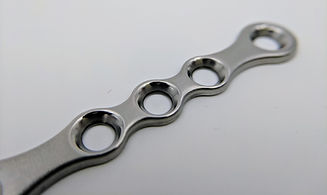
Orthopedic implants operate under cyclic loading conditions that can persist for millions of load cycles over a device’s lifetime. Edge definition, notch geometry, and surface condition influence stress distribution and fatigue performance, particularly in thin sections and transition regions. Even minor burrs or micro-notches left from mechanical machining can act as stress concentrators, increasing the risk of crack initiation under repetitive loading.
Traditional machining processes rely on tool contact and localized mechanical forces to remove material. In fine features (IE slots, small radii, narrow web sections) this contact can introduce minor deformation or require secondary deburring steps. Each additional handling or finishing operation introduces variability and process complexity, which must then be validated and controlled within a regulated manufacturing environment.
PECM removes material through controlled electrochemical dissolution rather than mechanical shear. Because the cathode does not contact the workpiece, thin features and delicate geometries can be machined with reduced risk of distortion. Burr formation is minimized, and edges can be defined in a controlled manner that supports downstream processes such as polishing, coating, or surface treatments.
For bone plates and fixation devices, dimensional consistency across hole arrays and slot features directly affects surgical alignment and fastener seating. Feature-to-feature repeatability ensures predictable interaction with screws and locking mechanisms, while part-to-part consistency simplifies validation and lot qualification. In production environments, this replication stability reduces rework and inspection burden.
Orthopedic components are commonly produced from materials such as stainless steels, cobalt-chromium alloys, and titanium alloys, each presenting distinct machining challenges. PECM provides a method for generating precision features in these conductive materials while maintaining controlled surface condition. As device designs evolve toward thinner profiles, more intricate geometries, and improved biomechanical performance, manufacturing processes must support that complexity without amplifying variability.
By integrating cathode design, pulse parameter optimization, and electrolyte control, Voxel supports orthopedic manufacturers in transitioning from prototype geometries to production-scale replication with predictable outcomes. In a sector where performance, regulatory compliance, and consistency intersect, process stability is key.

Download Our In-Depth Medical Industry Whitepaper

300μm microholes in copper

Demonstration of internal "s-shaped" non-line-of-sight finishing capabilities via PECM

PECM finishing on conal-shaped sample parts to demonstrate postprocessing capability
300μm microholes in copper
Request a
Feasibility Review
